You're Funding AI Wrong
It's a Tuesday afternoon in the quarterly business review and your CTO is eight slides deep into the AI agent program update. The room is expensive: twelve senior leaders, two hours blocked, catering nobody's touching. Slide after slide shows pilot results, accuracy metrics, demo videos, architecture diagrams. Everything looks impressive.
Then your CFO leans forward and asks the question that's been building for two quarters: "We've put $4M into this program. What's it giving us back?" The CTO pulls up a slide about "expected efficiency gains" and "projected time savings," but the numbers are modeled, not measured. Nobody in the room can point to a dollar saved, a process shortened, or a customer outcome changed. Five pilots have been funded, with promising results in controlled environments, but there's still nothing the CFO can take to the board and defend.
What happens next is the part I've watched play out in company after company. The CTO talks about model maturity and architecture decisions that are "de-risking production readiness." The CISO reframes the delay as responsible stewardship: three open risk assessments before any agent touches production data. The CDO produces a data-readiness roadmap that conveniently completes next fiscal year. Everyone is protecting their program, their budget, their headcount. Nobody is lying. But nobody is solving the actual problem either, because the problem isn't in any single leader's domain. It sits in the gaps between them.
Here's what I tell every leadership team living this moment. Most enterprises that stall with AI are funding it as a technology program when what they need is an operating model transformation. The models were never the hard part.
If you've been in enterprise technology long enough, the symptoms are recognizable. Funded programs, talented teams, promising technology, no production outcomes. We watched the same movie play out with data platforms about a decade ago. Companies spent millions standing up data lakes, hired the teams to run them, and the first use cases proved the value was real. Then it stalled, because nobody built the layer between a lake full of raw data and a business that could safely use it, and every new team that wanted in had to solve access, quality, and compliance from scratch. Gartner had a name for where most of them ended up: the data swamp. The one difference is speed- what took five years to become a crisis with data is taking about eighteen months with agents.
But failing to ship is only one of three ways this goes wrong. In my experience it isn't even the most expensive one.
Three ways to fail at AI agents
Failure mode 1: Never ship. Roughly 83% of US enterprises have funded agentic AI projects; about 41% have gotten one to production (Codiste, 2026). The pilots work. The demos impress leadership. Then the project hits security review, data-access negotiations, and compliance questions it can't answer, and it sits there until the next reorg quietly kills it.
Failure mode 2: Ship but can't prove value. This one is more insidious because from the outside it looks like success. The agent is in production. It's doing something. But nobody defined what success looked like before launch, so there's no baseline, no way to know if it's improving or degrading, no feedback loop tying it to the outcome that justified the spend. Six months later someone asks "what's the ROI?" and the honest answer is "we don't know." The agent keeps running because nobody wants to be the person who turns it off.
Failure mode 3: Ship too fast and lose control. This is where the organizations that moved aggressively without governance end up. They pressed GO across the enterprise, hoping that by enabling their employees with AI that would somehow turn into efficiencies. Now costs are climbing. Licenses are piling up across multiple vendors. Agents are running that nobody owns. Shadow AI is proliferating because lines of business deployed their own tools outside IT. When leadership asks "what do we decommission?" the answer is "we don't know what's running, let alone which ones to keep." The speed they gained by skipping governance is now costing more in cleanup than governance would have cost to build.
The pattern I see repeatedly: these aren't alternatives, they're sequential. Organizations hit #1, relax controls to break the bottlenecks, then hit #2 and #3 within a year.
The number that should end the debate
Databricks analyzed 20,000 organizations for its 2026 State of AI Agents report and found one result that speaks to all three failure modes at once: companies that implemented AI governance pushed 12x more projects to production than those that didn't.
That stat usually gets filed under "shipping." But that undersells it. Governance forces you to define success criteria before deployment, which is what fixes failure mode 2. And it creates the registry, identity, and evaluation infrastructure that prevents sprawl, which is what fixes failure mode 3. The same report found organizations using structured evaluation tools moved 6x more systems to production, not because evaluation slows things down, but because it gives the CISO evidence to approve a deployment in days instead of blocking it for months. Those same evaluation frameworks then double as the measurement layer that tells you whether an agent is delivering value after launch.
One investment addresses all three failure modes.
The budget inversion problem
BCG studied what actually drives AI outcomes and found a ratio that, frankly, explains most of the stalled programs I get called into.
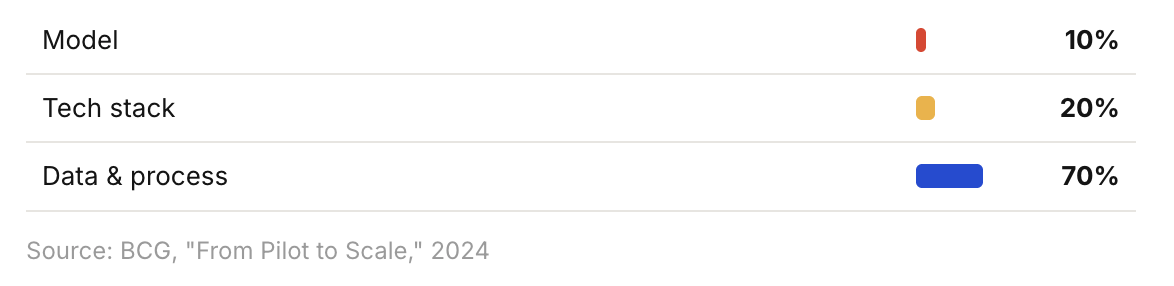
Look at that again, because the implication is brutal: the model and the stack it runs on account for less than a third of what determines success. The other 70% is organizational and operational: the connective tissue between "the technology works" and "the business gets value from it."
Now think about how most enterprises actually allocate AI budget. The majority goes to models, compute, and engineering talent. A fraction goes to data governance, success criteria, evaluation, and process change. The budget is allocated almost perfectly inverse to what the research says drives outcomes. I have yet to walk into a stalled program where this wasn't true.
And the cost of getting the order wrong compounds. Without governance infrastructure, organizations get locked into whatever they deployed first, paying last quarter's prices for last quarter's capabilities, because switching costs pile up faster than anyone budgeted. The companies I advise that treat governance as an acceleration investment keep the optionality to move when something better arrives. The ones that don't are stuck.
What the 12x companies actually built
The companies pushing 12x more AI to production built three things:
Agent identity. Every agent has its own identity, so you always know which agent took an action and who owns it. And when an agent acts for a person, it inherits that person's access limits, so it can never reach data the person couldn't reach themselves. When that employee leaves, their agents don't keep running on orphaned access. When leadership asks "what's running and who owns it?", there's an answer.
A control plane. One layer that knows what agents exist, what tools and data they can reach, what they did, and what they cost. Gartner named this category the "agent management platform" in March 2026. It removes the security-review bottleneck, provides the visibility to measure value, and gives you the inventory to manage sprawl.
Evaluation gates with success criteria. Not "test it before launch" but "define what success looks like, measure it continuously, and flag when it degrades." This is the line between agents that provably deliver and agents that run forever because nobody knows whether to keep them.
None of these slow you down. They remove the friction that creates the failure modes in the first place.
The question for your next board meeting
If you're the leader in that Tuesday QBR, watching demo after demo impress the room and move nothing on the P&L, be precise about what you're seeing. The technology works. What's missing is the operating model around it, the connection that turns a working demo into a result the business can count. That should be reassuring, because an operating model is something you own and can change.
It's also what now separates the companies winning with AI from the ones quietly losing money on it. Ernst & Young surveyed 975 executives at billion-dollar companies last year and found that firms with real oversight, meaning live monitoring and an actual governance committee, were far more likely to report revenue growth and cost savings than firms without it. Governance is what lets the value through.
So the question becomes one of timing. You can build this layer now, while your agent count is small, the architecture is still reversible, and the registry that tells you what's running costs almost nothing. Or you can build it later, after finance flags a charge nobody can explain and security is chasing an agent nobody owned, when the same work runs five to ten times the cost on a board deadline. The capability you end up with is identical. Only the price and the pressure change.
That's the whole decision. Every enterprise lands in the same place eventually. What you're choosing today is whether you get there by design or under duress.
"The companies governing their agents today are the same ones that governed their data a decade ago. The discipline that won them the last platform shift is winning them this one."
Three things to do Monday morning
1. Build an agent registry this quarter. You can't govern what you can't see. One registry, one identity per agent, one named owner. This is a weeks-level effort, not a years-level program.
2. Define success criteria before deployment, not after. What does this agent need to deliver? How will you measure it? What does degradation look like? Make it a launch prerequisite.
3. Fund governance from your AI budget, not your compliance budget. The budget owner sets the pace. If governance lives in compliance, it moves at compliance speed and fixes only one of the three failure modes. Put it where the urgency is.
All thoughts, ideas, and opinions expressed here are my own.
Sources
- Databricks, The State of AI Agents, January 2026 (12x production rate with governance, 6x with evaluation tools, 20,000 organizations analyzed)
- OutSystems, 2026 Agentic AI Production-Scale Survey, Q1 2026 (~1,900 IT leaders)
- Codiste, Enterprise Agentic AI Adoption Report, May 2026 (83% funded, 41% reached production)
- Gartner, Predicts 2025: AI Agent Project Cancellations, June 2025 (40% cancelled by end of 2027)
- Gartner, Agent Management Platform category definition, March 2026
- Boston Consulting Group, From Pilot to Scale: The AI Value Equation, 2024 (10% algorithms / 20% technology / 70% data and process change)
- Gravitee, 2026 Agentic AI Security Report (incident rate and detection-to-containment gap among ungoverned agents)
- IDC, 2024 (60% of organizations will fail to realize AI value by 2027 due to governance failures)
- PwC, 2025 Global CEO Survey (56% report zero financial ROI from generative AI)
- Transcend, AI Development Lifecycle Governance Survey, 2025 (93% hit data quality or governance blockers)
- Ernst & Young, EY survey: AI adoption outpaces governance as risk awareness among the C-suite remains low, September 2025 (975 executives surveyed on AI governance)